The Recipe Card Before the Cookbook
The recipe card before the cookbook shows how handwritten instructions carried household cooking knowledge, and how to read, preserve and use those records.
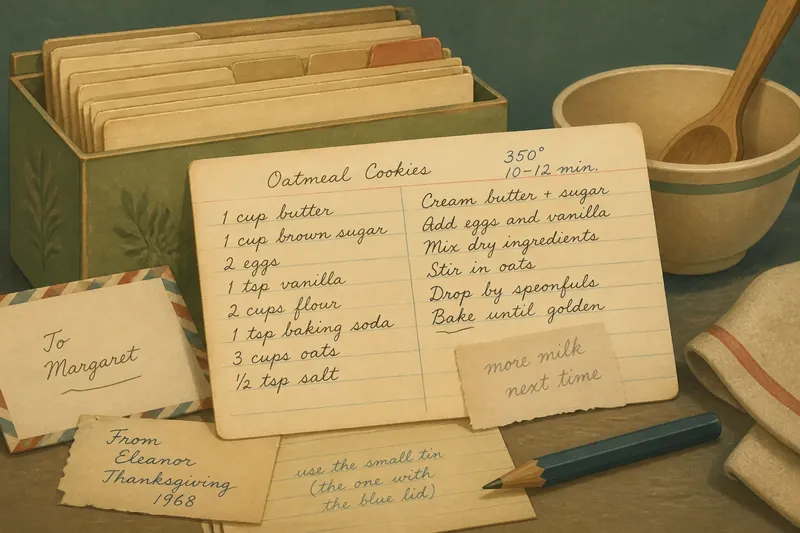
Who kept a family’s cooking knowledge before a cookbook could sit on the shelf? Often, someone wrote it on a recipe card: a portable record of ingredients, remembered proportions and useful corrections. The recipe card before the cookbook was not necessarily the first way people recorded recipes, but it offered a compact format for keeping instructions close at hand.
A card is best read as a household document, not a complete history of recipe writing. Its marks may tell you how one cook recorded a dish, what another changed and which details they assumed a later reader already knew.
A recipe card kept instructions close at hand
A bound cookbook stays in one volume; a loose card can be kept in a tin, an envelope or a drawer. That made it convenient to bring into a working kitchen or lend to someone, though convenience alone cannot tell us how widely cards circulated in any particular place or period.
The small format encouraged selection. A writer might include ingredients, a pan choice and a cue such as “bake until golden”, while leaving out a familiar technique. What is missing may reflect the writer’s assumptions, but it does not prove that every reader shared them.
If you borrow a card, return it in its sleeve or envelope and avoid adding notes to the original.
Handwriting can record transmission, not authorship
A card may have been copied from a relative, dictated while someone cooked or rewritten from another source. The hand on the card identifies a writer only if there is supporting context; it does not establish who first created the recipe.
Corrections, different inks and attached scraps can show that the document changed. They are clues to its use, not a complete account of who made each change or why.
Say you find a card with a neat ingredient list and a pencil note in another hand: “more milk next time”. You can transcribe both marks separately and note where each appears. The resulting record preserves the distinction without pretending to know who wrote the note or whether the adjustment was later adopted.
Keep additions visible and attributed where possible; do not turn uncertain clues into family history by tidying them away.
Household measures need their original context
Old cards may name a teacup, spoon, handful or familiar tin instead of a standardised quantity. These terms can refer to particular objects or routines, and their meaning may be difficult to recover from the card alone.
Even a written quantity leaves room for interpretation. Flour may be spooned or packed, eggs differ, and “until done” depends on a cook recognising the expected colour or texture. Treat the card’s wording as evidence of what was recorded, not as a complete modern formula.
For an archive, transcribe uncertain measures exactly as written and add your interpretation in a separate note. If you plan to cook from the card, make any adjustment in a working copy so the original remains readable.
Corrections show decisions made in a kitchen
A card can hold a substitution, a pan change or a reminder about texture. Such a note may reflect one cook’s circumstances, but the mark alone cannot establish whether it became a lasting household practice or how the dish changed across generations.
Imagine you inherit a card that says “use the small tin” but names no size. You could preserve that wording, then add a dated note to your own copy describing the tin you chose and what the finished dish looked like. A later cook would see both the inherited instruction and the limit of your interpretation.
When adding a correction, date or initial it and write on a separate copy if the original is fragile.
Cards may carry traces of social exchange
A name, occasion or note on a card can suggest that a recipe was shared. It cannot, on its own, establish how often it travelled or which community used it. Neighbours, relatives and groups may have passed recipes between households, but the surviving record will vary from place to place.
Keep envelopes and loose notes with the card if their connection is clear. A name or occasion can help explain its context; if the relationship is uncertain, record that uncertainty rather than attaching the note as fact. Store fragile originals dry and away from direct light, and use a transcription for regular cooking.
What can the recipe card before the cookbook tell you?
How can you tell who wrote a recipe card?
Look for names, initials, dates, handwriting changes and corrections, then treat each as a clue rather than proof. The person who copied the recipe may differ from the person who first developed it.
Why do old recipe cards use vague measures?
A card may refer to familiar household objects or assume a technique its first reader already knew. Without the original cup, tin or kitchen context, the intended meaning may remain uncertain.
Should you update an inherited recipe card?
Keep the original wording intact and put changes in a dated working copy or separate note. This lets you cook from your interpretation without confusing it with the older record.
How should recipe cards be stored?
Keep fragile cards dry, out of direct light and protected from unnecessary handling. A readable transcription gives you access to the instructions while leaving the original undisturbed.
The recipe card before the cookbook is a modest record of written instructions, not proof of a single route by which cooking knowledge travelled. Read its wording, handwriting and corrections carefully, and keep what you infer distinct from what the card actually says. That small distinction is often the most useful thing you can pass on with it.