Fresh Herbs: Chop Them In or Scatter Them Over?
Fresh herbs taste different depending on when they enter a dish. Choose the right timing for a clear herbal note, a deeper savour or both.
Should fresh herbs go into the pan or over the plate? For fresh herbs, timing decides whether they become part of a dish’s background or remain a clear, aromatic presence. The useful answer depends less on a rule about a particular herb than on what the dish needs: a lasting savour, a bright finishing note, or both.
Choose timing by the job the herb needs to do
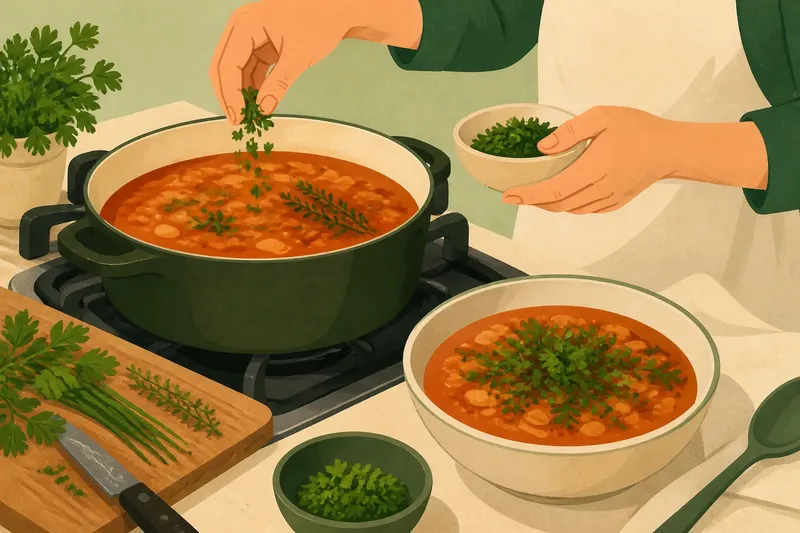
Heat, moisture and time soften many herbs’ sharp, fragrant qualities. Chopped parsley simmered in a stew becomes quieter and more integrated; parsley scattered over it just before serving smells vivid and tastes distinctly green. Neither treatment is inherently better. They produce different roles.
Adding herbs during cooking suits a dish that needs their flavour woven through its liquid, fat or vegetables. The result tends to be less sharply identifiable, but it can make the whole dish taste more rounded. Adding herbs at the end preserves a more immediate aroma and a clearer contrast with the cooked ingredients.
A split addition often makes sense when you want both effects. Put some herbs into the dish to contribute depth, then reserve a fresh portion for the surface. This is not an attempt to insure the dish against culinary catastrophe; it is simply two timings doing two different jobs.
Cook herbs in when they need time to mingle
Use herbs during cooking when the dish has a long simmer, a substantial sauce or a flavour base that would otherwise taste one-dimensional. Thyme in a bean stew, oregano in a tomato sauce and chopped rosemary in a braise can mingle with the surrounding ingredients while the dish cooks. Their flavour becomes part of the whole rather than sitting on top as a separate announcement.
For a soup, stew or sauce, add tender chopped herbs late enough that they do not lose all definition, but early enough to mingle before serving. A brief spell in hot liquid can soften their raw edge. If the pot will continue bubbling for a long time, reserve some of the same herb for the end instead of expecting the early addition to remain lively.
Robust herbs are generally more suited to longer cooking than delicate leafy ones. Thyme, rosemary, oregano and bay are commonly used to flavour simmering dishes; parsley leaves, dill and chives more often retain their appeal when added near serving. This is a working distinction, not a law. Chop size, freshness and the dish’s other flavours all change the result.
When the recipe calls for a whole sprig, the purpose may be to lend flavour without leaving chopped leaves throughout the dish. Add it while the liquid cooks, then remove the stem before serving. A bay leaf works on the same principle: it contributes to the background and is not meant to be eaten as a garnish with a confident face.
For a dish that will be cooked briefly, there may be little advantage in adding tender herbs early. They can go in close to the end, where the residual heat will soften them without making their flavour disappear into the pan.
Scatter herbs over dishes that need a fresh counterpoint
Finish with herbs when you want their smell to reach the diner before the first bite, or their flavour to interrupt a rich, creamy or deeply savoury mouthful. Chopped parsley over a buttery bean dish, dill over potatoes or coriander leaves on a warm lentil bowl can make the cooked base feel brighter and more distinct.
Finishing herbs do not have to be chopped finely. Roughly torn basil leaves can be more pleasant on a tomato dish than a fine mince, which may bruise the leaves and make them look limp. Tender leaves such as basil, mint and coriander often work well torn or left whole in small pieces. Chives and parsley are easier to distribute when sliced or chopped.
Add finishing herbs close to serving, rather than leaving them to sit under a lid on a hot pot. Trapped steam and residual heat can wilt delicate leaves quickly. If the dish must wait, keep the prepared herbs aside and scatter them on when serving is imminent.
Consider the surface as well as the flavour. A loose handful of leaves can make sense on a broad platter, while a small scattering of finely cut chives suits a bowl of soup. The aim is not decorative coverage. It is to make the herb easy to smell and taste in the same mouthful as the food beneath it.
Use both timings when a dish needs depth and lift
Some dishes benefit from a cooked herbal base and a fresh finish. A tomato sauce can take oregano during its simmer and basil after it comes off the heat. A stew might cook with thyme, then receive parsley at the table. The early addition gives the dish a joined-up savour; the late one supplies a clearer, fresher note.
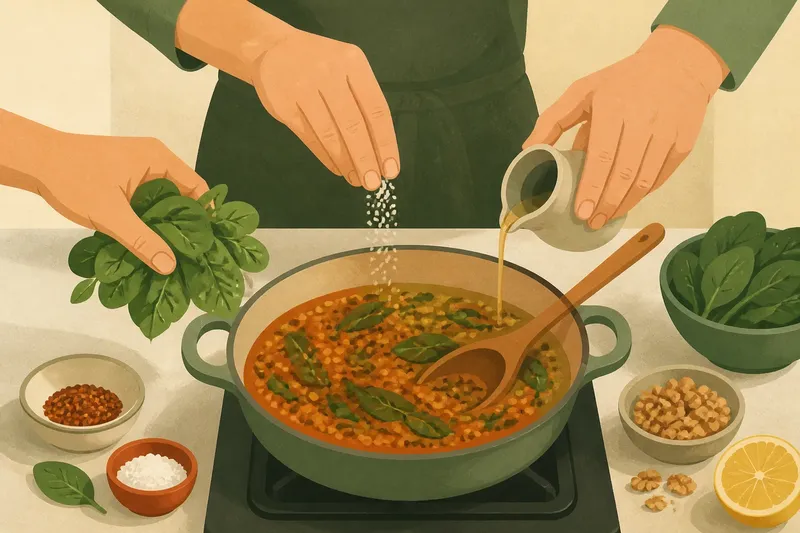
Imagine you have a pot of lentils that tastes wholesome but slightly flat. You stir chopped parsley into the pot and let it simmer for a while; its flavour is likely to become subdued and mingle with the lentils. Instead, reserve some parsley and add it after serving. The visible leaves and fresh aroma offer a sharper contrast, making the herbal note easier to recognise.
Keep the two additions distinct rather than doubling the amount automatically. If a recipe already calls for a generous quantity of herbs, dividing that amount between the cooking stage and the finish may be enough. Taste the dish before adding more: a fresh garnish can make existing seasoning feel more pronounced without requiring another handful.
Fresh herbs need different handling at each stage
For cooking, chop herbs to a size that suits the texture of the dish. Fine pieces distribute readily through a smooth sauce; larger pieces can be welcome in a rustic stew. Remove woody stems from herbs such as rosemary if their texture would be unpleasant, while tender stems may be usable when finely cut. If a recipe specifies otherwise, follow its intended texture.
For finishing, cut or tear herbs shortly before they are needed. A sharp knife helps make clean cuts; crushing leaves under a blunt blade can leave them bruised and darkened. Pat washed herbs dry if excess water would dilute a dressing or cling to the leaves in clumps. Keep delicate herbs away from direct heat until the dish is ready.
The way a herb is stored also affects its usefulness. Limp leaves may still contribute to a sauce or stock, where their appearance matters less, but they are a poor choice for a fresh garnish. Save the most intact leaves for the surface and use sound, less tidy pieces in the cooking stage.
Which timing suits this dish?
Should parsley go into soup or on top?
Use parsley in the pot if you want its flavour softened and spread through the broth. Add it at the end if you want a distinct green aroma, or divide the amount between both timings when the soup needs both.
When should basil go into tomato sauce?
For a clear basil aroma, add tender leaves at the end or scatter them over the served sauce. A smaller amount cooked into the sauce gives a more integrated flavour, while a final addition keeps the herb easier to recognise.
Can fresh herbs be added to a dish after it has cooled?
Yes, if the dish is meant to be served cool or at room temperature, finishing herbs can bring a fresh contrast without any heat to soften them. Add them near serving so they do not sit in dressing or moisture long enough to wilt.
Why do herbs seem to disappear in a long-cooked dish?
Long cooking softens their aroma and lets their flavour blend into the surrounding ingredients. Use a robust herb for the cooked stage, then add a fresh portion at the end if you want its scent and taste to remain distinct.
Let the dish settle the choice
Before chopping, ask what would improve the dish more: a flavour threaded through the food or an herbal note that stands apart. A long-cooked stew usually has room for herbs in the pot, while a simple plate of potatoes may benefit more from dill scattered at the end. Sauces, soups and grain bowls can often accommodate both, provided the finishing portion stays fresh.
When a recipe gives a specific timing, treat it as part of the intended flavour, not an arbitrary instruction. Where it leaves the choice open, add herbs early for integration and late for aroma. For a dish that feels dull but already has a cooked herbal base, try a small fresh scattering before reaching for more salt or spice. Fresh herbs are often most useful when their timing is chosen as carefully as their variety.