The Pinch Is Not a Tiny Teaspoon
Learn how to read a pinch, handful or splash by its job in a recipe, so you can choose a sensible amount without turning every meal into a measuring exercise.
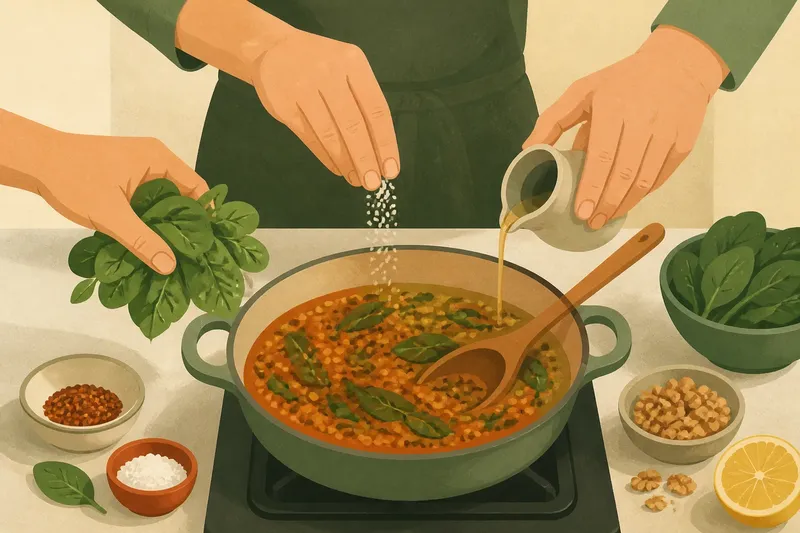
How much is a pinch of salt, a handful of spinach or a splash of vinegar? In a recipe, these informal measures are not disguised units waiting to be converted; they describe amounts by the job they do. The useful question is what the ingredient needs to accomplish, and how much room the dish leaves for adjustment.
A pinch is sized by your fingers, a handful by your hand, and a splash by the pour. Those vary between cooks and ingredients, but the variation is not always a flaw. A handful of baby leaves and a handful of chopped walnuts occupy space differently; a splash of water is less consequential than a splash of lemon juice. Read the measure alongside the ingredient, the stage of cooking and the flavour of the finished dish.
Informal measures carry different kinds of information
Recipes use household measures for convenience, but informal ones often communicate more than quantity. They can signal that a precise dose is unnecessary, that the ingredient should be added gradually, or that the cook should judge the result by taste, texture or appearance.
Consider the difference between “add a pinch of salt” and “add a pinch of saffron”. Salt is commonly adjusted to balance a dish; saffron is distinctive and costly, so a small amount may be there to provide its particular aroma and colour. The same word does not imply that the ingredients should be treated alike.
Three ways of reading these measures are useful:
- As a small initial dose: add a little, taste or inspect, then decide whether more is needed.
- As a customary serving amount: use an amount that fits the ingredient and the quantity of food being made.
- As a texture cue: add enough to create the change the recipe describes, such as loosening a thick sauce.
The right reading depends on what can be observed next. If the recipe offers a clear cue, use it. If it does not, begin conservatively when the ingredient is strongly flavoured or difficult to remove.
Read a pinch by its flavour job
A pinch often appears where the recipe needs a modest adjustment rather than a fixed formula: salt to bring other flavours into focus, sugar to soften sharpness, or spice to add a quiet background note. It can also be a conventional small dose of a potent ingredient, such as ground chilli. The word is an invitation to judge, not a promise that every cook’s fingers hold the same amount.
Before adding it, ask whether the ingredient is easy to correct. Unsalted cooking water can take more salt; a finished, over-salted soup is harder to repair. A pinch of pepper can be followed by another, while a heavy pinch of cayenne may dominate the bowl. Add the first amount, stir it through, and allow the flavour to reach the part of the dish where you will taste it.
Say you are making a pot of lentils and the recipe calls for a pinch of ground cumin. If cumin is meant to sit behind the lentils rather than lead them, start with a restrained amount, stir, and taste once it has warmed in the dish. Add more only if its aroma is still barely present; the aim is a supporting note, not an impromptu cumin soup.
Read a handful by the ingredient’s shape
A handful is especially variable because ingredients pack differently. Tender leaves collapse when compressed, chopped nuts settle into gaps, and grated cheese can form a loose pile. The cook’s hand is also part of the measure: a broad palm holds more than a small one. Here, the recipe may be asking for an approximate share of the dish rather than a standard volume.
Look at whether the handful is meant to dominate, garnish or provide texture. A handful of greens stirred into a pan may wilt and shrink; a handful of seeds scattered on top remains visible and crunchy. Compare the amount with the main ingredient and the number of portions, then add more if the mixture looks sparse or stop if the secondary ingredient is taking over.
When consistency matters, a recipe that gives a weight or a volume is more useful than one that says “a handful”. Follow that stated measure instead of substituting your own hand. When the recipe is deliberately flexible, let the ingredient’s role decide: a modest handful for a background accent, a fuller one when it is part of the substance of the dish.
Read a splash by what it changes
A splash may add liquid, loosen a mixture, release browned food from a pan, or sharpen flavour. These are different jobs. Water or stock can thin a sauce; vinegar or citrus juice can shift its acidity as well as its texture; wine can contribute liquid and flavour. The word describes an informal pour, but the intended change gives you a better guide than the sound of it hitting the pan.
For loosening a thick mixture, add liquid in small pours and look for a consistency that can be stirred or poured as the recipe intends. For flavour, add an acidic splash cautiously, mix it in, and taste before adding more. If the recipe names a particular liquid, its character is part of the instruction; replacing lemon juice with water might thin a dressing but will not make it taste brighter.
A pan sauce offers a clear distinction. A splash of stock may loosen browned residue and create enough liquid for a spoonable sauce. A splash of vinegar may cut through richness but can become conspicuous if poured freely. The phrase is the same; the ingredient’s task is not.
Which approach suits the recipe?
Should I use my fingers for a pinch?
Yes, if the recipe is asking for an informal small amount and your fingers are a practical way to add it. For a potent seasoning or a dish that is hard to correct, use a restrained pinch first and taste before adding another.
How do I judge a handful of leafy greens?
Think about whether the greens wilt into the dish or stay as a topping, then compare their volume with the other ingredients. If they are meant to be a garnish, add enough to distribute across the servings without hiding the food underneath.
How much liquid counts as a splash?
There is no single household amount that suits every liquid or recipe. Add a little at a time, watching for the requested texture or tasting for the intended flavour change.
When should I measure instead?
Use the recipe’s stated weight or volume when it gives one, particularly where the amount is central to the result or needs to be repeated consistently. Informal measures suit flexible seasoning and adjustment; they are not a reason to ignore a precise instruction.
Choose the measure that matches the decision
Use a pinch when the recipe calls for a modest flavour adjustment and you can assess it as you go. Use a handful when the ingredient’s contribution is more important than exact uniformity and its shape makes hand measurement practical. Use a splash when the liquid is added to reach a texture or flavour cue that you can observe.
For a dish you make repeatedly, note the version you prefer in ordinary language: “a small splash of cider vinegar” or “a generous handful of spinach”. That record helps you reproduce your own judgement without pretending that a hand or pour is a universal measuring tool. The pinches, handfuls and splashes in recipe reading are useful precisely because they leave room for the cook to respond to the food.